Hardware - Behind the scenes
Chopping block | Creating the Beast | Voices from the Deep
The Lost Boys | The Real McCoy | The Oddballs | Hardware comics
Chopping Block [top]
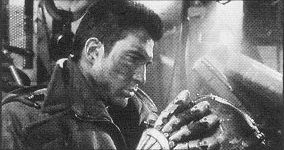 Mo was originally scripted as a junkie, having lost his right hand in an industrial accident and becoming addicted to painkillers. He also was radioactive and had cancer. Jill had a thing for his scars and the metal hand and liked to tattoo him. Miramax said the drugs and the tattoos had to go, the latter because they'd had bad experiences with a movie called Tattoo. This modifying pretty much eliminated the original "Hell's Angel" setting for Mo. Mo was originally scripted as a junkie, having lost his right hand in an industrial accident and becoming addicted to painkillers. He also was radioactive and had cancer. Jill had a thing for his scars and the metal hand and liked to tattoo him. Miramax said the drugs and the tattoos had to go, the latter because they'd had bad experiences with a movie called Tattoo. This modifying pretty much eliminated the original "Hell's Angel" setting for Mo.
The hand stayed intact though, which lead to Miramax wanting to include additional dialogue to explain the viewers how Mo got it in the first place. Most of this dialogue, written by a Miramax-hired scribe Mike Fallon, was included in a dinner scene which took place after Mo and Jill had sex. It was eventually left in the cutting room floor.
"[The Chief's death] was OK. There should've been more blood, but on the whole it works. Vernon, the other cop, gets the shorter-shrift, he's shot in the head, whereas originally he was meant to get shot in the balls. This was supposed to be one of the movie's nastiest moments. The guy's left alive, then cut up with a chainsaw. The actor had a page in the script of screaming and begging as his spine was severed so he couldn't move, beseeching Jill to help him. But she can't because the droid is using him as bait to get her. Effects-wise, it would have taken two days to shoot, but we were at the end of the schedule so all we could do was shoot him in the head." [Richard Stanley in Fangoria #97.]
The scene was supposed to make Chief's comment after the chess match ["Machines don't understand sacrifice - and neither do morons!"] foreshadowing of Vernon's fate.
Upon its US release, the film received an X-rating from the MPAA. The filmmakers and Miramax appealed twice to get the rating down to an R, since an X-rated release would'nt have been commercially viable. Both times they lost with only one vote and finally agreed to make Chief die faster.
"You're allowed to tear people in half so long as you kill them but if they're alive it comes under the heading of torture. [...] The only thing Palace and Miramax made me take out was the footage of real death, which was part of a TV documentary running in the background in one scene." [Richard Stanley in Fangoria #97.]
"In the sex scene, where Jill is sitting on top of Mo, they're making love and there's a blue-white flicker on both of their faces and you can see... she's sitting on top of him, but isn't really looking at him. In fact, she's watching the television over the bed. All those shots of what she's seeing on the televison have been removed. Originally she was watching scenes of real death. And they wanted it all cut out. You can only see a few clips of light when she's riding him, but they're not tied to the TV anymore. So instead now, as they're trashing around on the bed, you can imagine corpses sliding into mass graves, and their limbs mixing with the limbs of the corpses, those blurry shots which are missing from even the complete version. That "This is what you want, this is what you get" -thing was too heavy for everyone. Steve Woolley, the producer, actually cut that out." [Richard Stanley in Sex & Guts Magazine #3.]
Creating the Beast [top]
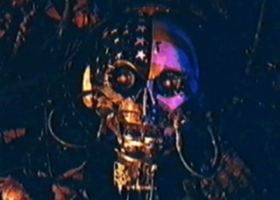 MARK-13 has two separate religious references; first being the obvious, a quotation of The Gospel according to Mark. The second is revealed as Alvy checks up the serial number he got from the droid's severed hand. Prior to a long string of numbers there's BAAL, standing for Bioelectronic Artificially intelligent Autoindependent Lifeform. Baal is an ancient pagan god, worshipped as the lord of rain and thunderstorm and also the earth's fertility. Not a bad name for a population control droid with a defect in its insulation system. MARK-13 has two separate religious references; first being the obvious, a quotation of The Gospel according to Mark. The second is revealed as Alvy checks up the serial number he got from the droid's severed hand. Prior to a long string of numbers there's BAAL, standing for Bioelectronic Artificially intelligent Autoindependent Lifeform. Baal is an ancient pagan god, worshipped as the lord of rain and thunderstorm and also the earth's fertility. Not a bad name for a population control droid with a defect in its insulation system.
The MARK-13 robot was designed by Paul Catling with the help of Bob Keen. Prior to Hardware, Keen had worked on another famed British horror movie, Clive Barker's Hellraiser. (This explains the certain similarities between the droid rebuiliding itself in Hardware and the main antagonist's resurrection in Hellraiser.) There were mainly two different versions of the droid. The first of one was a fibreglass suit worn by an actor, the other an animatronics version. "One of the animatronic robots had a lot of powerful motors inside it, and if there was any radio interference it would go mad and it's so strong it just ripped itself apart," Catling tells in an interview by Dark Star.
The filming of the droid became an exhausting exercise. Stanley recalls:
"We had two crews working, so we were on set shooting for 24 hours a day. So when the main unit clocked off to leave, when they switched off the lights at six o'clock or something, the second unit would move on, and switch the lights back on again and get going with the droid walking around, or anything that didn't involve the principal cast. Which was quite a lot, really.
That way I could just go on shooting for as long as I could stay awake. And keep going. I think it was just a matter of taking the time we had, and the amount of money we had, and squeezing it for every insanity we could get. I'd try to take rest dozes, and every time I went to sleep, I'd gone missing. It got to the point where I knew that every time I'd stop and lay down, we'd have one less pick-up shot. One less angle." [Originally appeared in Sex & Guts Magazine #3.]
Two of the special robotics technicians of the film, Chris Cunningham and Stephen Norrington, have later gained reputation also as directors. Norrington made his feature debut with the 1995 scifi-actioner Death Machine, which includes Bill Hootkins suffering a nasty end in the hands of a robot - again. Cunningham has later become an acclaimed music video director by his work with Aphex Twin and Björk.
Voices from the Deep [top]
|
Composer Simon Boswell ended up doing Hardware, because Richard Stanley had seen his name in several Italian horror movies either produced or directed (or both) by Dario Argento.
"I did about twenty [Italian films], at least, before I did anything else, but the ironic thing is that I didn't even do them in Italy. That first one of Dario's [Phenomena] was the only one I actually recorded there. All the others were done in our little place in Clapham, where we lived at the time."
Boswell's first British film was definitely a memorable experience while compared to his work with giallo.
"It was certainly more fun, simply because I was more involved in the film and I was on board whilst they were shooting it. They shot HARDWARE at the Round House in Camden Town and I was able to go down to the set and watch what was going on. Unusually, the director, Richard Stanley, decided that I should write some music on the basis of rushes and on the script, and play it to the cast whilst they were shooting, to show them what might be happening when it was all finished. That hasn't happened to me on any film since. Actually, I think it's quite a good idea." [Originally appeared in Simon Boswell - A Man Alone.]
|
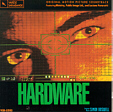 |
| A CD-R copy of the Hardware soundtrack is available at Vidjunkie. |
|
It's possible that Stanley adopted this method from Argento himself, who had film music played on the set at least during the shooting of Suspiria.
"Simon describes his score for Hardware, due out on video in February, "as if a Celtic Ry Cooder on acid had discovered God and decided to write an opera". For the film's climax, an Aliens-style battle between the tough heroine and a self- regenerating killer robot, he visualised "a scene in heaven - with Jimi Hendrix, Stravinski and the Moscow State Choir all jamming in a very small room".
"It was interesting to me because it has this weird mix of spaghetti western, horror and futuristic styles - it's like using a sampler. And because of the range of visual styles, musically I could do a whole range of styles too. I enjoyed it, and I think the album I've done is more interesting than the average soundtrack album." [Originally appeared in A New Track Record.]
The Lost Boys [top]
Stanley originally wanted Bill Paxton cast as Mo, paired with Jeffrey Combs as Shades. Combs was lost because the British Labour Union laws allowed to hire only two Americans. (At this time, Stacey Travis was already onboard.) Paxton, however, who was very enthusiastic about the film, would've probably starred in Hardware - but the people in Miramax and Palace Pictures didn't know practically anything about him. Therefore they didn't bother to seek out his agent and during this period Paxton signed on for Navy SEALS.
John Lydon, the frontman of Public Image Limited, was rumored to be in talks to provide the nasal squeak for Angry Bob, the insane DJ of WAR radio channel. The part eventually went to Iggy Pop, yet Lydon is still heard in the film's soundtrack in the PiL track Order of Death. Ironically enough, the cast listing in the back cover of the Japanese laserdisc credits Lydon for the part!
The Real McCoy [top]
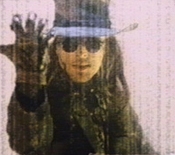 The Nomad is played by Carl McCoy, vocalist of the goth rock band Fields of Nephilim. Prior to Hardware, Stanley had directed some music videos for them (Preacher Man and Blue Water) and designed album covers (at least Dawnrazor). According to him, McCoy's character in Hardware is basically the same as it was in the Nephilim work. The character, then titled Preacher Man, had a prostethic hand, yellow contact lenses and wore an old black coat with a cowboy hat. Ring a bell? The Nomad is played by Carl McCoy, vocalist of the goth rock band Fields of Nephilim. Prior to Hardware, Stanley had directed some music videos for them (Preacher Man and Blue Water) and designed album covers (at least Dawnrazor). According to him, McCoy's character in Hardware is basically the same as it was in the Nephilim work. The character, then titled Preacher Man, had a prostethic hand, yellow contact lenses and wore an old black coat with a cowboy hat. Ring a bell?
[See also Music Videos.]
McCoy was originally scripted to appear in Jill's dream sequence in the middle of the film. The scene wasn't shot because of the actress' illness during the filming in the desert. Also, the band was in talks to contribute to the film's soundtrack. This didn't happen since the production company, Palace Pictures, was tied in with Virgin. They preferred the soundtrack to be made by 'in-house' artists.
|
The Oddballs [top]
When Alvy, the dealer, says the MARK-13 head is junk and insists on buying it, Mo reminds him it's Christmas, saying: "You should know that, you used to be an elf, didn't you?" Alvy gives him a somewhat disheartened look for the comment. Prior of filming Hardware, actor Mark Northover was denied a job as an elf at Santa's Workshop, since the owners thought he'd scare the children.
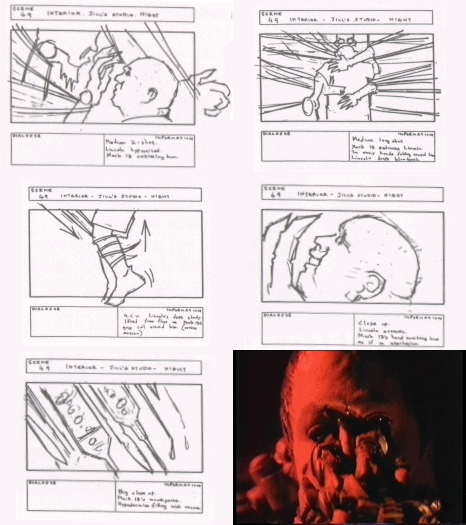
Jill's obnoxious neighbor, played by Bill Hootkins, is based on an actual person, who even sang the 'wibberly wabberly' song. When Stanley was a kid, the guy tried to pick him up. Guess it was way past time to get even.
For his appearance as the cabbie, Lemmy was equipped with a bottle of Scotch and a genuine Magnum revolver. He emptied the bottle and drew the gun out from his shoulder holster. It slipped his hand and sank to the river. Divers were sent to recover it, but they were unsuccesful.
|
 |
Hardware Comics [top]
SHOK!
When Hardware first came out, British comic book company 2000AD (e.g. Judge Dredd) sued the filmmakers for using their comic strip SHOK! as a basis for the film. The case was settled by giving the strip creators Steve McManus and Kevin O'Neill a credit. The strip has several similarities to the film, starting with the premise. An astronaut buys a SHOK trooper head from a scrap merchant as gift for his artist girlfriend, whom he later on leaves alone in her apartment. The droid head builds itself a torso - only from the waist up, though - and goes to kill the woman. Compared to the MARK-13, SHOK is much more verbal, having a voice of its own to throw tantrum with.
All and all, SHOK is Hardware stripped bare to the bone; one long action scene with the woman and the droid.
Interesting sidenote: The film Hardware is often (IMHO, misleadingly) compared to, The Terminator, encountered a similar dispute with the scifi-novelist Harlan Ellison.
Read SHOK! here
Hardware: Acid Reign
Comic book scribe Jim Campbell was - among others - once attached to do a comic book followup for Hardware.
"There _was_ some talk of a sequel to Hardware, but as a comic strip. I know this because Hardware: Acid Reign was one of my many almost-made-it projects.
Acid Reign was proposed (originally) as a 4-issue American style mini-series with me as scripter, Peter Doherty on board as series artist and Duncan Fegredo signed up as cover artist. The series was a direct sequel to the film, using all the same (surviving) characters and had Richard Stanley onboard as a script consultant (basically, he gave me license to use three or four elements from his original screenplay which had to be dropped because they were too expensive to film).
Mike Richardson at Dark Horse was very keen on the idea but, sadly, at the same time DC published an entirely unrelated comic also called Hardware. Since no-one in their right mind wanted to take on Time-Warner's lawyers, the project was essentially dead in the US. It was then touted to Fleetway (who hold the comic rights anyway), but of course Steve MacManus [SHOK! co-writer] said he'd sooner stick pins in his eyes (or something similar) than have anything to with that particular movie." [Originally appeared in the 2000AD FAQ.] |