Dust Devil - The Final Cut
Review by -sic_est-

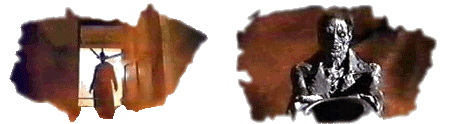
The Great Namib has a way of taking care of its own. Infernal winds blow cities to sand, swallowing abandoned houses, service stations and drive-in theatres. When people are abandoned, the winds take the shape of man, a dust devil. He is to liberate them from their worthless existence and help their spirits to pass on. In the beginning of the film, the dust devil (played by Robert John Burke) is summoned. The town of Bethany is slowly but surely dying, as are its residents. His first victim is woman, suffering of a loveless marriage and a lonely life. Through a complicated ritual, which involves sex, mutilation and decorating the woman's final resting place - in this case, her house - with her remains, the dust devil frees the soul and grows stronger in his effort to overcome his own material being.
The desert calls for those longing for redemption. This includes policeman Ben Mukurob (Zakes Mokae), to whom life has little to offer after his son was killed in a shooting and his wife left him. He's assigned to investigate this grisly murder, and feels it more and more personal as he goes on. Another person in an inner turmoil, is Wendy (Chelsea Field), heading towards the ocean through the wastelands, running away from an abusive husband. They are both going straight towards the dust devil, who knows they're coming.
Dust Devil is Richard Stanley's follow up to Hardware, and it basically takes everything that worked in his previous film and replaces the soft spots. For instance, one of Hardware's greatest flaws, the plot, was derived and linear to the max. Dust Devil is much more ambitious in this department, having several different plot lines starting scarce, yet being knit together throughout the film. We are introduced to the devil's work by Ben Mukurob, who's trying to get to the bottom of the killings and to its counterpart, the devil's soul, for encountering Wendy awakes passion in his fleshbound shape. Finally, there's Wendy's husband Mark (Rufus Swart), who heads to the desert to reclaim his wife. Above and beyond all this is the witch doctor of Bethany, Joe Niemand (John Matshikiza), who knows what's going on and remains in the only still place in the spiral - the center.
A multilayered story such as this is very hard to keep together, and the problematic post-production (which ultimately led to some lost scenes) didn't do the film any favors. Knowing all this it's pleasently surprising to find out that Stanley not only manages to keep the story together, but also as interesting and atmospheric. Stanley seems to feel that the modern day world is even more depressing than the future, since while Hardware offered a blink of hope, Dust Devil has the characters go deeper into their personal abyss' every step of the way.
Dust Devil is at least as spiritual as Hardware, with almost every single character out of place or uncertain. What is our place in the world, between science and magic? What can we believe in? Robert John Burke takes every scene he's in with a soft, subtle portrayal of the dust devil. The devil has a heart like everybody else, being unsure at times about the path he's taken. There is no good and evil, but is the matter always inferior to the spirit? Is his work fate, a mission from a higher being, or is there a choice?
Chelsea Field and Rufus Swart as the Robinson family, Wendy and Mark, start with an unimpressive breakup, which renders Stanley a bit lost when trying a portray middle-class life in the suburbs. Once both of them are heading towards the Great Namib, they have become scarred and continue to get some more. Wendy's trying to get her life together, while Mark comes face to face with his own shortcomings as a husband and as a man.
Mokae as Mukurob and Matshikiza as his guide to the other side do a convincing job as old men, who are about to face the future in which they have no part on. The difference is in their takes on that future: Mukurob is frightened, trying to correct the past by doing the right things in the present, while Niemand realizes how everything just goes around and around. The cycle of life, death and rebirth.
This wild story is wrapped together much more subtly than Hardware. The musical score is very tight and concentrated, with Simon Boswell certainly topping himself while creating melancholic, somber tunes that could be straight from a Sergio Leone film. The same goes to the visual output, with most of the Hardware crew returning, this time shooting slow, beautiful camera drives all around the Namibic landscape. That's the main difference between the two films, as if it would be fair to compare them. In Hardware, everything goes straight to Hell when it gets going. Dust Devil slides there, doing a spiral as it goes. It all happens slowly, so that you can feel the heat growing larger and perhaps even realize what's happening - when it's too late.
Dust Devil is Richard Stanley's Once Upon a Time in Namibia, a sad story about sad people. In the end, there is no hope, for only the Devil will have his day. |