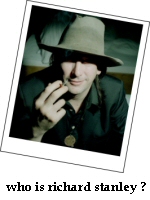
Richard Stanley / The Espoo Ciné Interview, part IV
by Lauri Löytökoski, August 28th, 2004, transcribed by Dejan Ognjanovic
Richard Stanley visited the Finnish film festival Espoo Ciné in August 2004, presenting all of his major works (two feature films, three documentaries, and one short film) during a three-day retrospective. I first met him during the second day of the retrospective, when he was about to screen The White Darkness and The Voice of the Moon. He was gracious enough to agree for this interview. This segment covers a bit of the Questions and Answers that followed the screenings of Voice of the Moon and The White Darkness.
RS: "It's a shame about the tape [of THE WHITE DARKNESS], cause there's so much [on it] that you couldn't see, in the background. You got all of the obvious stuff, but the subtlety, the things going on around, expressions on people's faces were lost. But [there were] no problems with the voodooists, the actual voodoo people believed that we'd been brought there by the spirits, that we were there to take their message back to the West. And in fact we shot about 250 hours of material, of which we put out two half-hour episodes on BBC, but this film was made out of the pieces that we couldn't show on TV, because of nudity, or animal violence or because of the American military presence. The only people that gave us a hard time were the actual marines: no one told us that the island was under occupation before we got there. We went there to shoot a voodoo doc and instead the problem was the Americans were not meant to be present in Haiti, but at the same they were very present there, and kind of came out at us. At first we told them we were there to shoot a doc on religion around the world and they assumed it to be Christianity..."
The Afghan people preferred Ennio Morricone music more than a lot of classical and rock music Stanley brought from the West: they really went for the soundtrack for The Good, The Bad and The Ugly, so the score for Voice of the Moon came out that way.
"I look back on the day I was on the back of the horse, riding towards the battle as the best day of my life..." Stanley has native American blood in him, and wants to believe that they are descendants of the Asian people who came there over the Pole and felt with them as with 'my people, the original people'.
"I was looking for a shamanic faith that I haven't quite found. I'd heard that further in the mountains there were people still possessed by the animals they hunted, there were wild wolves there, there were villages no one wanted to go to because the people there were not human but wolves wearing human skin, and I was very drawn by that... I'm kind of glad that roads and electric power haven't gotten there yet, and I kind of hope that it stays in the state of anarchy that it's in now, that we'll never really civilize them."
Islam was brought to Afghanistan in 1910, and the guy who brought it had all 'pagan' priests executed and temples destroyed - but it was very recent, and this earlier faith is still strong...
"The further you go into the mountains, the further you go back in time. My feeling is always, that if I went far enough, [or if I'd] gone further, I might've gone far enough back in time to get to before the arrival of Islam. I was looking for some of the original shamanic people who I'm sure are still there. All those stories about the places Muslims won't go in the mountains made me very intrigued. Afghanistan is the place where ideologies come to die: British empire, Genghis Kahn, collapse of the Russian effort... But the Islam itself might come to an end in the country. I never saw the shariah being enforced outside of the city." Everybody was stoned, forgetting the rules and duties. Stanley himself had a long hair, a beard and heavily tanned, and pretended to be a mountain man from a different village.
|